
Invoice Number Format: How to Number Invoices
In this guide
- Why invoice numbers matter
- The rules every numbering system should follow
- Common invoice number formats compared
- How to start: your first invoice number
- One sequence or several?
- Gaps, voided invoices and corrections
- Numbering credit notes, quotes, receipts and purchase orders
- Recurring and subscription invoices
- Invoice numbers and the law in different countries
- Numbering when several people or tools issue invoices
- File names and invoice numbers
- Examples for different kinds of business
- A worked example: setting up a system in ten minutes
- Numbering for different invoicing situations
- Accounting software, spreadsheets and generators
- What your numbers can tell other people
- Checking your sequence
- Situations that come up
- International and formatting details
- How to fix a messy numbering history
- Numbering for online shops and high volumes
- Why not simply use the order or job number?
- Conventions in particular industries
- Sole traders, partnerships and companies
- Are predictable invoice numbers a risk?
- How long to keep the register
- Quick answers to common numbering questions
- A short checklist
- Numbering and accounting periods
- Different currencies and separate series
- Matching invoice numbers to bank payments
- Putting it into practice
An invoice number looks like the least important part of an invoice, and it is one of the most useful. It is the reference you and your client use in every email and payment, it is how your accountant checks that nothing is missing, and in many countries it is a legal requirement. A sensible system takes ten minutes to set up and saves hours of confusion later.
This guide explains the rules that matter, compares the common formats with examples, and shows how to handle the awkward cases: gaps, credit notes, several series and starting from scratch. If you just want a number suggested for you, the free invoice generator adds one automatically and proposes the next number when you start a new document.
Quick answer: Give every invoice a unique number, keep the numbers in sequence, never reuse one and do not leave unexplained gaps. A simple running count (1, 2, 3) or a year-based pattern (2026-001) is enough for most businesses.
Why invoice numbers matter
A number does five jobs.
- Identification. “Invoice 1042” is unambiguous. Without it, you end up describing the invoice: “the one from last month for the website”.
- Payment matching. Clients quote the number in their bank transfer reference, and your bookkeeping matches the payment to the invoice by it.
- Control. A sequence shows what has been issued. A missing number is a prompt to look for a missing invoice.
- Tax and audit. Tax authorities use numbers to check that every sale has been recorded. In several countries a sequential number is mandatory.
- Professionalism. An invoice with a clear number looks organised and is easier to process.
If you are new to invoicing, the guides on how to make an invoice and what to include on an invoice show where the number sits in the document.
The rules every numbering system should follow
Whatever format you choose, follow these six rules.
| Rule | Why |
|---|---|
| Unique: no two invoices share a number | Prevents confusion and satisfies tax rules |
| Sequential: numbers increase in order | Makes gaps visible and audits easy |
| Never reuse a number, even for a cancelled invoice | Keeps records consistent |
| No unexplained gaps | A gap looks like a missing invoice |
| Consistent format: same length and pattern | Easier to sort, read and search |
| Human-friendly: short enough to type and say aloud | Clients quote it in payments |
The tax side deserves a moment. In the United Kingdom, HMRC’s VAT guidance requires a full VAT invoice to carry a sequential number, based on one or more series, that uniquely identifies the document. EU VAT rules likewise expect a sequential number. In the United States there is no federal rule, but the same practice is the standard way to keep clean records. Our UK VAT invoice guide covers the UK requirement in more detail.
Common invoice number formats compared
There is no single correct format. These are the patterns businesses actually use, with the trade-offs.
| Format | Example | Good for | Watch out for |
|---|---|---|---|
| Plain sequence | 1, 2, 3 … 1042 | Freelancers and very small businesses | Does not show the year; easy to guess volume |
| Padded sequence | 0001, 0002 … 0420 | Sorting in file lists | Needs a decision about length |
| Year and sequence | 2026-001, 2026-002 | Most small businesses | Restarts each year |
| Year, month and sequence | 2026-10-014 | Higher volume | Longer to type |
| Prefix and sequence | INV-0042 | Businesses with several document types | Needs a prefix for each type |
| Client code and sequence | ACME-014 | Agencies with a few large clients | Each client has its own counter; keep overall uniqueness |
| Project or job code | P2310-02 | Project-based work | Needs a project register |
| Date-based | 20261014-01 | Daily batches | Hard to count how many in total |
For most people, year and sequence (2026-001) is the best balance. It is short, it tells you when the invoice was issued at a glance and it restarts neatly each year.
Plain sequential numbers
The simplest system: start at 1 and add one for each invoice. It is easy to explain and impossible to get wrong. Its weaknesses are cosmetic: it does not show the year, and a very new business shows “Invoice 3” to a client, which some owners dislike. If that bothers you, start at 100 or 1000, or use a year-based format. Starting at 1000 is purely a presentation choice and has no legal effect.
Year-based numbers
Add the year to the front: 2026-001. It reads well, it makes archiving easy and it avoids four-digit counters growing forever. Because the year is part of the number, restarting the sequence each January does not create duplicates. Use a consistent length, such as three digits after the year, and plan for more than 999 invoices a year if that is possible.
Prefixes for document types
If you issue several types of documents, prefixes keep them separate and recognisable:
| Document | Prefix | Example |
|---|---|---|
| Invoice | INV | INV-2026-014 |
| Credit note | CN | CN-2026-003 |
| Proforma invoice | PF | PF-2026-002 |
| Quote | QT | QT-2026-021 |
| Purchase order | PO | PO-2026-008 |
| Receipt | R | R-2026-017 |
The tools on this site follow the same idea: invoices, receipts, quotes and the other documents each have their own number, so numbers never collide across types. See the receipt generator, quote generator and credit note generator.
Client-based numbers
Some agencies use a client code and a counter per client: ACME-014, GLOBEX-007. Clients like it because their invoices read as their own sequence, and staff find it easy to look up. The risks are that numbers across the business are no longer a single sequence (which some tax rules expect) and that two clients can produce the same counter value. If you use client codes, keep a single overall register or make sure each full number is unique and each client’s counter has no gaps.
What to avoid
- Random strings or UUIDs. They are unique but impossible to say, sort or sanity-check.
- Numbers that encode private data, such as the client’s phone number.
- Mixed formats within one sequence (some with a prefix, some without).
- Spaces and special characters such as slashes, which break file names and some systems.
- Resetting without a marker. Restarting at 1 each year without the year in the number creates duplicates.
How to start: your first invoice number
New businesses often wonder whether the first number says something about them. It does not. Clients care that your numbering is orderly, not what the first number is. Your options are:
- Start at 1. The simplest and entirely fine.
- Start at 1000 or another round number if you prefer your first invoice not to look like the first one.
- Start with a year pattern, such as 2026-001.
If you have already issued invoices without a system, find the highest number you used and continue from the next one. If your earlier invoices were unnumbered or inconsistent, pick a start date, begin the new system from there and keep a note of the earlier documents. A clean break is better than trying to retrofit numbers to old invoices.
One sequence or several?
For most small businesses, one sequence is enough. You may want several when:
| Reason | Example |
|---|---|
| Different legal entities | Each company has its own series |
| Different locations or branches | London: LON-001; Leeds: LDS-001 |
| Different currencies or tax regimes | EU invoices in one series, UK in another |
| Different document types | INV, CN, PF each with its own counter |
| Different invoice streams | Subscription invoices vs project invoices |
Each series should still be consecutive and unique within itself, and your records should say which series covers what. Tax authorities generally accept several series as long as each is orderly and documented.
Gaps, voided invoices and corrections
Mistakes happen, and how you handle them matters more than the mistake.
You created an invoice but never sent it. If it never left your hands, you can usually void it. Keep a record, mark it “Void”, note the reason and do not reuse the number.
You sent an invoice with an error. Do not edit it quietly. Issue a credit note that refers to the original, and then a new invoice with the next number. The guide on what a credit note is explains the process.
You sent the same number twice. Cancel one of them with a credit note, reissue it under a new number, and tell the client which is the correct one. Write down what happened.
A number is missing from the sequence. Find out why. If it was a draft that was abandoned, record it as void with the date and reason. An unexplained gap is what an auditor asks about.
You deleted an invoice. Avoid this. Deleting makes the sequence look broken and removes your evidence. Keep voided documents.
Numbering credit notes, quotes, receipts and purchase orders
Each document type should be numbered, and the relationship between them should be visible.
- Credit notes have their own numbers (in the invoice series or a separate CN series) and always quote the number of the invoice they correct.
- Quotes and estimates are numbered separately. When a quote is accepted, you can carry its number onto the invoice as a reference (“Quote QT-2026-021”).
- Receipts are numbered separately and quote the invoice number they settle.
- Purchase orders are numbered by the buyer. When you invoice against one, put the buyer’s PO number on your invoice, in addition to your own invoice number.
This cross-referencing is what lets someone follow a transaction from the quote to the payment. Our guide on purchase order vs invoice shows how the numbers line up.
Recurring and subscription invoices
Recurring invoices are still invoices, so each needs its own number. Do not reuse the same number each month. A good pattern is to include the period or a running count:
- INV-2026-014 for the October retainer, INV-2026-015 for November.
- ACME-RET-2026-10 for the October retainer from a client with a retainer series.
State the period covered in the description (“Retainer, October 2026”) so the client knows what the number refers to. If your invoicing tool creates recurring invoices automatically, check that it increments the number and does not repeat it.
Invoice numbers and the law in different countries
This is a general summary, not legal advice.
| Country | Numbering rule in short |
|---|---|
| United Kingdom | A full VAT invoice needs a sequential number, based on one or more series, that uniquely identifies the document |
| European Union | Invoices need a sequential number or numbers, under the EU VAT rules as applied by each member state |
| Canada | The CRA’s GST/HST invoice requirements concentrate on the supplier, date, amounts and registration number; an invoice number is still best practice and many businesses and customers expect one |
| Australia | A tax invoice must carry specific details such as ABN, date and GST amount; sequential numbering is best practice |
| United States | No federal format; sales tax is by state. Sequential, unique numbers are the standard practice for records |
Where a rule exists it is usually about uniqueness and sequence, not about the exact format. You are free to choose the prefix and length, and the rule is to keep it orderly.
Numbering when several people or tools issue invoices
Collisions happen when two people or two tools both create “the next number”. Avoid them:
- Use one source of truth. One invoice register, one spreadsheet or one accounting system that assigns numbers.
- Reserve blocks if you must. If two people issue invoices, give each a prefix or a block of numbers, such as A-001 and B-001.
- Do not mix tools. If you use a generator and a spreadsheet, record the numbers in one place so the next number is always known.
- Check before sending. Look at the last invoice number you issued.
A browser tool such as Invoicz suggests the next number from your last document when you choose New document, and your History keeps the numbers you have used on that device. If you also invoice from another computer, note the number elsewhere, because History does not travel between devices.
File names and invoice numbers
The invoice number is the best part of a file name, because it makes the file searchable and sortable. A pattern that works:
ClientName_invoice_1042.pdf
or, for year-based numbers:
2026-014_ClientName.pdf
Avoid spaces and slashes. Invoicz names the downloaded file after the first line of the “Bill to” box and the invoice number, for example Awasi_Umar_invoice_1042.pdf.
Examples for different kinds of business
| Business | Suggested format | Why |
|---|---|---|
| Freelancer, 5 to 30 invoices a year | 2026-001 | Short, shows the year, easy to restart |
| Small agency with ongoing clients | INV-2026-0142 | Prefix for clarity, room for volume |
| Online shop | ORD-100245 for orders, INV-2026-0087 for invoices | Order and invoice numbers are separate |
| Tradesperson | 2026-0045 | Simple, matches the job book |
| Consultancy with projects | P2310-INV-02 | Project code and sequence within it |
| Multi-branch business | LON-2026-0031 | Branch prefix keeps series apart |
If you are unsure, use the year and sequence pattern. It works at almost any size.
A worked example: setting up a system in ten minutes
Suppose you are a freelance developer with about 40 invoices a year. Here is how you would set it up.
- Choose the format. Year and sequence:
YYYY-NNN. - Decide the start. The first invoice of 2026 is
2026-001. You will restart at2027-001each January. - Decide the series. One series for invoices. Credit notes use
CN-2026-001. Quotes useQT-2026-001. - Create the register. A spreadsheet with these columns:
| Number | Date | Client | Amount | Due | Paid on | Status |
|---|---|---|---|---|---|---|
| 2026-001 | 6 Jan | Northwind Cafe | $720.00 | 20 Jan | 18 Jan | Paid |
| 2026-002 | 14 Jan | Bluebird Studio | $1,450.00 | 28 Jan | Overdue | |
| 2026-003 | 29 Jan | Northwind Cafe | $360.00 | 12 Feb | 10 Feb | Paid |
| CN-2026-001 | 3 Feb | Bluebird Studio | -$150.00 | Credit for 2026-002 |
- Write the rule down. “Invoices are numbered YYYY-NNN and increase by one. Voided numbers stay in the register marked Void. Credit notes are CN-YYYY-NNN.”
- Use it every time. Before creating an invoice, look at the register for the last number.
That is the whole system. It takes ten minutes to set up, and from then on every invoice is numbered in seconds.
Numbering for different invoicing situations
Some situations raise the question “do I need a new number?”. The answer is nearly always yes.
| Situation | Numbering |
|---|---|
| Deposit invoice, then final invoice | Two invoices, two numbers; the final invoice shows the deposit paid |
| Progress invoices on a project | One number per invoice; reference the project or contract on each |
| A client asks for the invoice to be split between two departments | Two invoices, each with its own number, both quoting the same order |
| A client asks for the invoice to be reissued with a different address | Cancel with a credit note and issue a new invoice with a new number |
| A late reminder for the same invoice | Same number; it is a reminder, not a new invoice |
| An invoice sent again because the client lost it | Same number, same content; clearly marked as a copy if needed |
| A statement summarising several invoices | A statement has its own reference; it lists the invoice numbers |
The principle is that an invoice number identifies one request for payment. A new request gets a new number; a reminder about the same request keeps its number.
Accounting software, spreadsheets and generators
Different tools handle numbers differently, and it is worth knowing how yours behaves.
| Tool | Behaviour | What to check |
|---|---|---|
| Accounting software | Assigns the next number automatically, often with a configurable prefix | That the setting matches your format and starting number |
| Spreadsheet template | Numbers are typed by hand or built with a formula | That you did not copy a row and forget to change the number |
| Invoice generator | Suggests the next number from your last document or lets you type one | That you keep your own register if you use it on several devices |
| Word or Docs template | Entirely manual | That you save each invoice under its own file name |
If you move between tools, carry the sequence over: set the new tool’s starting number to the next unused one. Do not start again at 1 and create duplicates of old invoices.
What your numbers can tell other people
An invoice number reveals how many invoices you have issued, which some businesses prefer not to share with clients or competitors. If that matters to you, you have two simple options.
- Start at a higher number, such as 1000, which is a purely cosmetic choice.
- Use a client-specific series, so a client sees only their own count, while you keep a master register.
These choices are about presentation. They do not change the legal need for orderly, unique numbers.
Checking your sequence
Once a month, spend five minutes checking that the sequence is sound:
- Sort your register by number.
- Look for gaps and duplicates.
- For each gap, find the document or record the reason.
- Match each paid invoice to a bank payment.
- Make a note of anything that needs a credit note.
A tidy register is the single best thing you can show an accountant at year end. It turns tax time into a review rather than a search.
Situations that come up
You start mid-year. Start the sequence on your first invoice date. If you use a year-based format, begin at 001 for that year.
You change your business name or become a company. Start a new series for the new entity, with its own prefix, and keep the old register closed but safe. Invoices from the new entity must carry its own details.
You switch invoicing software. Export your old register, set the new software’s next number to the first unused one and keep the old numbers searchable. Do not recycle numbers.
You take over another business’s customers. Their invoices stay in their records. You continue your own sequence.
Two partners both issue invoices. Give each a prefix or block, or use one shared register that assigns numbers.
A client asks you to use their format. Some large buyers require a specific pattern or extra reference. You can include their reference in addition to your number, but keep your own sequence intact.
You need to issue an invoice dated in the past. Use the next number in the sequence but show the correct supply date. Do not insert an invoice with a number from the past, because that breaks the sequence. Check local rules on back-dating.
International and formatting details
A few small points help when invoices cross borders and systems:
- Separators. A hyphen is the safest separator. Slashes and spaces cause trouble in file names and some systems.
- Case and characters. Use capital letters and digits. Avoid accents and special characters in numbers.
- Length. Many systems allow a limited number of characters in a reference field, often 16 or 20. Keep numbers short enough to fit.
- Leading zeros. Spreadsheets can strip leading zeros. If you use
0042, store it as text. - Dates. If you include a date, use year first so numbers sort correctly.
How to fix a messy numbering history
If your numbering is already a tangle, you can tidy it without rewriting history.
- List what exists. Gather every invoice you have issued, with numbers and dates.
- Find the duplicates and gaps. Note each one and, if you can, the reason.
- Fix duplicates by correction. Cancel one with a credit note and reissue it under a new number, and tell the client.
- Choose a start point. Decide the date or number from which the new system applies.
- Write the rule down. Prefixes, length, restart policy, how to record voids.
- Keep a register. One list, updated every time you issue an invoice.
A record of what happened and why is what an auditor or your accountant will want, far more than a perfect sequence.
Numbering for online shops and high volumes
If you sell many small orders, the invoice number needs to scale. Three points help.
Keep order numbers and invoice numbers separate. The order number identifies what the customer bought and appears in the shop and in emails. The invoice number is the accounting document. They can be linked, with the invoice quoting the order number, but they should not need to be the same. Tax rules care about the invoice number being sequential; an order number may skip when payments fail or baskets are abandoned.
Allow for growth. If you expect thousands of invoices a year, use at least five digits after the year (2026-00001) so the length does not change, and avoid formats that include the day, which multiply the number of digits.
Automate, but verify. An online shop usually assigns numbers automatically. Check once a month that the sequence has no gaps from failed jobs, and keep a note of any voided numbers.
Why not simply use the order or job number?
It is tempting to use a project, order or job number as the invoice number. It can work when each job produces exactly one invoice. It breaks when:
- A job has a deposit, progress invoices and a final invoice (several invoices share one job number).
- A job is cancelled before invoicing (a gap appears in the job numbers, not in your invoices).
- Different jobs are invoiced together.
The cleaner approach is to keep the job number as a reference on the invoice and give the invoice its own number. That way you can follow a job from quote to payment and still keep an orderly invoice sequence.
Conventions in particular industries
Some trades have habits you may want to follow so your invoices fit their records.
| Industry | Common habit |
|---|---|
| Construction | Job or contract number plus an application or stage number, for example J2310-APP03 |
| Legal and accounting | Matter or client number with a period, for example M1204-2026-10 |
| Consulting | Client code and month, for example ACME-2026-10 |
| Wholesale and distribution | Branch prefix and long sequence, for example LDN-0045821 |
| Subscriptions | Customer ID with a period counter |
These can be good ideas inside your own team, but do not let them break the basic rules. The invoice number still has to be unique, and the sequence still has to be traceable.
Sole traders, partnerships and companies
The legal form of your business changes who the invoice is from, and so how your numbers are organised:
- Sole trader: one series is enough. You are the seller.
- Partnership: one series per partnership. If partners also invoice separately for their own work, each keeps their own series with a prefix.
- Limited company: the company issues the invoices, and the series belongs to the company. If you change from sole trader to company, start a new series for the company.
- Group of companies: each legal entity needs its own series, because each is a separate seller for tax purposes.
When in doubt, ask which entity is the seller on the contract, and use that entity’s series.
Are predictable invoice numbers a risk?
Sequential numbers are predictable, and some people worry about that. For ordinary business invoicing it is not a problem, because the number is not a secret and does not give access to anything. A few sensible habits remove any remaining risk:
- Do not use the invoice number as a password or link token. If you send payment links, make sure they are not simply the invoice number.
- Do not publish a public list of invoices. Send each invoice only to the person it is for.
- Confirm bank details by phone when an invoice request is unusual, regardless of the number.
- Be cautious with unexpected invoices. Fraudsters sometimes send invoices that look like yours with the next number. If a client forwards a doubtful one, check your register.
A well-kept register is the best defence: if a number is not in it, you did not issue it.
How long to keep the register
Keep the numbering register for as long as you keep the invoices themselves. The period depends on your tax rules, commonly several years. A register is small, so keep it indefinitely if you can. It lets you answer “was invoice 2024-017 ever issued?” without searching boxes of files.
Quick answers to common numbering questions
Should the number include my initials or business name? Only if it helps you. A short prefix such as INV is clearer than a name, and it keeps numbers compact.
Can I use the date as the number? You can (20261014-01), but it is harder to count and easier to duplicate on a busy day. A year plus a running count is safer.
Is it a problem if a client pays without quoting the number? No, but you will have to match the payment by amount and date. Make it easy by writing “Please quote invoice 2026-014 when paying” in the payment instructions.
Do quotes and invoices share a sequence? No. Keep them separate with different prefixes, and carry the quote number onto the invoice as a reference so the two can be linked.
What if I run out of digits? Plan the length ahead. If you used three digits and reach 999, add a digit (2026-1000) rather than reusing numbers, and note the change in your register.
A short checklist
| Check | Yes |
|---|---|
| Every invoice has a unique number | |
| Numbers run in order with no unexplained gaps | |
| The same format is used for all invoices | |
| Credit notes, quotes and receipts have their own numbers | |
| Voided numbers are recorded, not reused | |
| The next number is easy to find | |
| File names include the number |
Numbering and accounting periods
Your numbering interacts with your accounting year in a few ways that are worth planning for.
Calendar year or financial year. If your financial year does not match the calendar year, you can base the number on either. Choose one and stay with it. A calendar-year number is easiest for clients to read; a financial-year number makes year-end reports simpler. If you use a financial-year label, make it unambiguous, for example FY26-014.
Restarting the count. Restarting at the start of a period is fine as long as the period is part of the number. If a number appears in two periods, the year (or financial year) is what keeps them distinct.
Year-end checks. Before closing the year, confirm that every number from the first to the last is accounted for: issued, paid or void. Any invoice issued in one period and paid in the next should still carry the original period’s number.
Quarterly tax returns. If you file quarterly, a register that shows invoice number, date and tax makes the return a matter of adding up a column.
Different currencies and separate series
If you invoice in several currencies, you can keep one sequence and show the currency on each invoice, or keep a series per currency. Both are acceptable. A single sequence is simpler. Separate series by currency can help if each is booked into a different bank account or ledger. Whichever you choose, state the currency on the invoice next to the total and in the register.
Matching invoice numbers to bank payments
The invoice number is the key that links an invoice to a payment. Make it work for you:
- Ask clients to quote the number as the payment reference, and say so in the payment instructions.
- Look for the number first when reconciling your bank statement. If the reference is missing, match by amount and date.
- Record the number against the payment in your register, so each invoice shows a payment date or an open balance.
- Handle one payment for several invoices by listing each invoice number on the receipt.
A habit of reconciling weekly keeps the open items short and shows early which invoices are slipping.
Putting it into practice
Decide on a format, write the rule in one sentence (“Invoices are numbered YYYY-NNN, starting at 001 each January”), and use it every time. The invoice generator will suggest the next number and name the file for you. When you are ready to go further, read what to include on an invoice for the full checklist and invoice payment terms to set how soon you get paid.
Frequently asked questions
What should my first invoice number be?
Any number works as long as it is unique and you keep counting upwards. Starting at 1, 001 or 1000 are all fine. A pattern with the year, such as 2026-001, makes the sequence easier to read. Clients do not judge how new your business is by your numbers.
Do invoice numbers have to be sequential?
In many tax systems, yes: a VAT or GST invoice usually needs a unique number, often in a sequence. Even where it is not required, sequential numbers make gaps visible and records easier to audit, so it is the safest choice.
Can I skip an invoice number?
Avoid it. A gap makes it look as if an invoice is missing, and an auditor may ask where it went. If you must void an invoice, keep it, mark it cancelled and record why instead of deleting it or reusing the number.
How do I number credit notes?
Give credit notes their own numbers, either in the same sequence or in a separate series with a clear prefix such as CN-001. Each credit note should also quote the number of the invoice it corrects.
Should invoice numbers restart every year?
You can. Many businesses include the year and restart the count, for example 2026-001 then 2027-001, which keeps numbers short. If you restart, the year must be part of the number so it stays unique.
Can I use letters in invoice numbers?
Yes. Prefixes such as INV, a client code or a year are common and useful. Keep them consistent, avoid special characters and spaces, and make sure the full number is unique.
Do I need a separate sequence for each client?
Not usually. One sequence for the whole business is simplest and satisfies most rules. A client code in the number is fine for readability, but the overall numbering should stay unique across all clients.
What happens if two invoices have the same number?
It causes confusion in payments and accounts, and a tax authority may query it. Correct it by cancelling one with a credit note and reissuing it under a new number, and keep a note of what happened.
Related guides
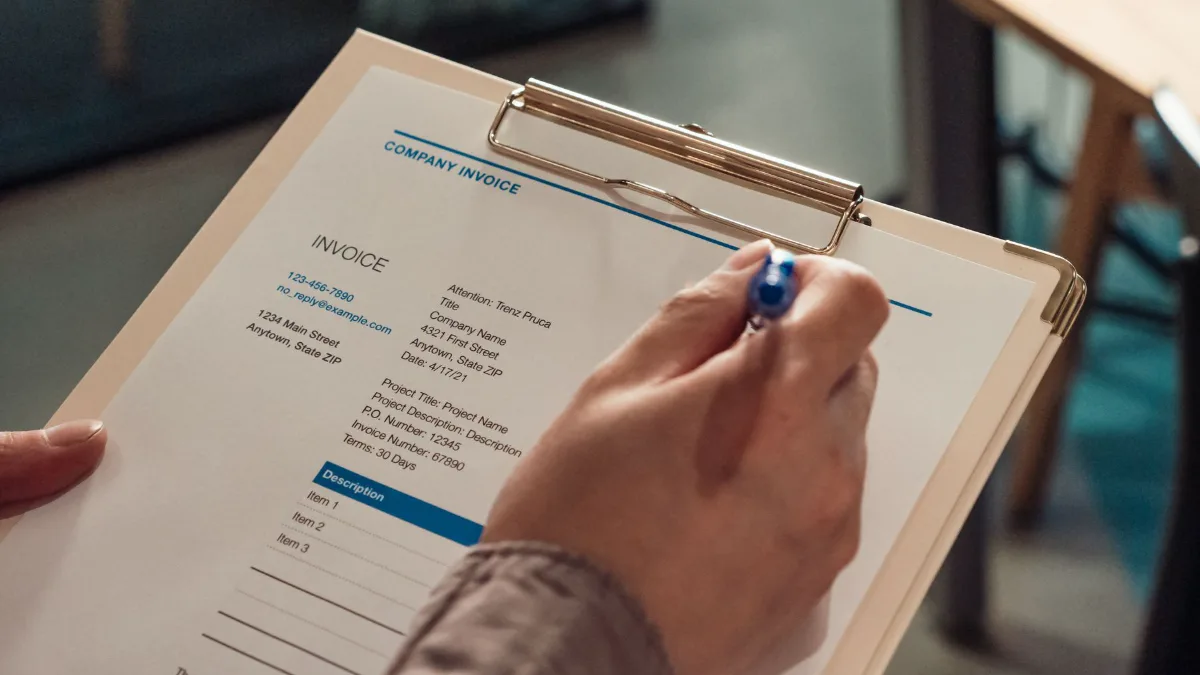
How to Make an Invoice: Step-by-Step Guide
Learn how to make an invoice in 8 clear steps: what to include, how to number it, set payment terms, add tax and send it to get paid on time.
What to Include on an Invoice: Checklist
Every element a professional invoice needs, from numbers and dates to tax and payment terms, with UK, US, Canada and Australia notes.

What Is a Credit Memo or Credit Note? Meaning
A credit memo (credit note) reduces or cancels an invoice. Learn what it is, when to issue one, what it must include and how it differs from a refund.
Invoice Payment Terms: Net 10, Net 30 and More
What invoice payment terms mean: how Net 10, Net 30, 2/10 net 30 and due on receipt work, how to choose the right terms and how to write them clearly.