
What Is an Invoice? Meaning, Types, Examples
In this guide
- The simple definition of an invoice
- What an invoice is used for
- The parts of an invoice
- A simple invoice example
- The main types of invoices
- Invoice vs bill vs receipt vs quote vs purchase order
- Where the invoice fits in a sale
- Who issues an invoice, and who receives it?
- Is an invoice legally binding?
- Does an invoice mean I have to pay, or that it has been paid?
- Invoice terms you will see on real invoices
- How invoices work in different kinds of business
- How an invoice is checked on the buyer’s side
- Who issues invoices: individuals, sole traders and companies
- How to spot a fake or fraudulent invoice
- A note on tax: inclusive and exclusive prices
- Paper, PDF and electronic invoices
- The life of an invoice: statuses
- Invoice examples for different kinds of work
- Why invoices matter for cash flow
- How to read an invoice you have received
- What an invoice is not
- How long should you keep invoices?
- Common misunderstandings about invoices
- How to create an invoice
- Common beginner questions about invoices
- Invoices and finance: why lenders care about them
- A short history of the invoice
- Key takeaways
An invoice is a document a seller sends to a buyer that lists what was supplied, what it costs and when it must be paid. In plain words, an invoice is a request for payment. If you have ever bought something for a business, hired a freelancer or been asked to pay “by invoice”, you have met one.
This guide explains what an invoice means, what it is used for, what it contains, the different types, how it differs from a bill, a receipt, a quote and a purchase order, and how it fits into the life of a sale. There are examples throughout, and a glossary of the terms you will see on real invoices. When you are ready to make one, the free invoice generator takes a couple of minutes.
Quick answer: An invoice is a commercial document issued by a seller to a buyer. It identifies the seller and the buyer, gives a unique number and date, describes the goods or services, shows the amounts including any tax, and states how and when to pay. It is a request for payment, not proof that payment was made.
The simple definition of an invoice
The word comes from the old French envoyer, “to send”, and the idea has not changed much: an invoice is something you send to someone to tell them what they owe.
A good definition has three parts:
- It records a sale. It says who sold what to whom, and when.
- It states a price. It shows the quantities, the unit prices, any discount or tax and the total.
- It asks for payment. It says how much is due, by when and how to pay.
That is why people also call it a sales invoice (from the seller’s side) or a supplier invoice or vendor invoice (from the buyer’s side). It is the same piece of paper. The seller is raising it; the buyer is processing it.
What an invoice is used for
An invoice does four jobs at once, which is why it is worth getting right.
It asks to be paid. This is the obvious purpose. Without an invoice a business customer’s accounts team usually has nothing to approve and nothing to pay against.
It records the sale for both sides. The seller records income; the buyer records a cost or an asset. Accounting systems on both sides are built around invoices.
It supports tax. In most countries invoices are the basis for sales tax, VAT or GST. A buyer who is registered for tax may only be able to reclaim the tax if they hold a proper invoice. Authorities can ask to see invoices during an audit.
It protects both parties in a dispute. If a customer says “I never agreed to that price”, the invoice, together with the quote or order it refers to, is the written record of what was supplied and charged.
If you are a freelancer or a small business owner, an invoice is also the thing that turns finished work into cash. Our guide on how to make an invoice shows the process step by step.
The parts of an invoice
Invoices look different, but nearly all of them contain the same building blocks. The table below shows each part and why it is there.
| Part | What it contains | Why it matters |
|---|---|---|
| Heading | The word “Invoice” (or “Tax invoice” where required) | Makes clear what the document is |
| Seller details | Name, address, contact, tax number | Identifies who is asking for payment |
| Buyer details | Name and billing address (and PO number) | Lets the buyer match it to the order |
| Invoice number | A unique reference | Used in payments, queries and records |
| Dates | Issue date, due date, sometimes supply date | Starts the payment clock and fixes the tax period |
| Line items | Description, quantity, unit price, line total | Shows exactly what is charged |
| Subtotal, discount, tax, shipping | The calculation | Lets the buyer check the total |
| Total and balance due | The amount to pay | The number the buyer needs |
| Payment terms | When and how to pay, late fees | Sets expectations |
| Notes | Thank you, project name, references | Adds context |
For a complete checklist with explanations, see what to include on an invoice.
A simple invoice example
Here is what a small, ordinary invoice looks like. A freelance photographer is billing a client for a half-day shoot.
Invoice 0027 | Issue date: 14 October 2026 | Due: 28 October 2026 (Net 14)
From: Mia Torres Photography, 14 Garden Row, Portland, OR 97201, mia@example.com Bill to: Northwind Cafe, 88 Harbor Street, Portland, OR 97209
| Description | Qty | Rate | Amount |
|---|---|---|---|
| Half-day food photography shoot, 4 hours, 9 Oct | 1 | $480.00 | $480.00 |
| Image editing, 20 final photos | 20 | $12.00 | $240.00 |
| Usage licence: website and social media, 2 years | 1 | $150.00 | $150.00 |
| Total due | $870.00 |
Payment: bank transfer, reference “Invoice 0027”. Notes: Thank you for choosing Mia Torres Photography.
Everything a client’s accounts team needs is there: who, what, when, how much and how to pay. Any invoice you read will be a variation on this.
The main types of invoices
“Invoice” is a family of documents. These are the ones you are most likely to meet.
| Type | What it is | When it is used |
|---|---|---|
| Standard (sales) invoice | A request for payment for goods or services supplied | Almost every ordinary sale |
| Tax invoice / VAT invoice | An invoice that meets tax authority rules and shows tax | Where tax law requires a specific format |
| Proforma invoice | A preliminary invoice sent before delivery; not a demand for payment | Advance payment, customs, quotes that need approval |
| Commercial invoice | The invoice used for international shipments and customs | Cross-border sales of goods |
| Credit note (credit memo) | Reduces or cancels a previous invoice | Returns, errors, discounts after the event |
| Debit note | Adds a charge or corrects an under-charge | Extra costs or price corrections |
| Recurring invoice | The same invoice issued on a schedule | Subscriptions, retainers, rent |
| Interim or progress invoice | Bills part of a project as it advances | Construction and long projects |
| Final invoice | Bills the remaining balance at the end | After deposits or stage payments |
| Timesheet invoice | An invoice based on hours worked | Freelancers and contractors billed by time |
| E-invoice | A structured electronic invoice exchanged between systems | Large companies and some government buyers |
A proforma invoice and a commercial invoice are easy to confuse; our guide on pro forma vs commercial invoice explains when each is correct. A credit note is the standard way to correct an invoice; read what a credit note is.
Invoice vs bill vs receipt vs quote vs purchase order
These documents are used together, and mixing them up causes real delays. This table puts them side by side.
| Document | Who sends it | What it says | When |
|---|---|---|---|
| Quote or estimate | Seller | “This is what it will cost” | Before the work |
| Purchase order | Buyer | “We want to buy this” | After agreeing a price |
| Invoice | Seller | “You owe this amount” | After (or on) delivery |
| Bill | Buyer’s term for the seller’s invoice | “We need to pay this” | When processing payment |
| Receipt | Seller | “Payment received, thank you” | After payment |
| Credit note | Seller | “We are reducing what you owe” | After a correction or return |
The invoice sits in the middle. The documents before it set the price; the documents after it close the loop. If you want the detail, read invoice vs receipt vs bill, quote vs estimate vs invoice and purchase order vs invoice.
Where the invoice fits in a sale
Here is the usual sequence for a business-to-business sale. Smaller sales skip steps, but the order is the same.
- Enquiry. The buyer asks for a price.
- Quote or estimate. The seller states what it will cost and for how long that price is valid.
- Agreement or purchase order. The buyer accepts, often by sending a purchase order with a PO number.
- Delivery. The goods are shipped or the work is done. A packing slip or delivery note often travels with goods.
- Invoice. The seller sends an invoice that refers to the order.
- Approval. The buyer’s accounts team matches the invoice to the order and the delivery.
- Payment. The buyer pays by the due date.
- Receipt. The seller records the payment and, if asked, sends a receipt.
Each document refers to the one before it, which is why numbers such as the quote number and PO number matter on an invoice. An invoice that quotes the PO number is paid faster, because the accounts team can approve it against an order they already know.
Who issues an invoice, and who receives it?
The seller (also called the supplier, vendor, contractor or payee) sends the invoice. The buyer (the customer, client or payer) receives it.
For the seller, the invoice goes into accounts receivable: money owed to them. For the buyer, the same invoice goes into accounts payable: money they owe. That is why one document has so many names. A freelancer says “I invoiced my client”. The client’s finance team says “we received a supplier invoice”. They are talking about the same page.
If you are the seller, your goal is a document that is easy to approve. If you are the buyer, your goal is to check that it matches what you ordered before you pay.
Is an invoice legally binding?
An invoice is not a contract on its own. It is a document that records and requests payment for a transaction, which is usually based on a contract, a quote you accepted or an order you placed.
In practice:
- If you agreed to buy something and received it, the invoice is a formal demand for the amount you agreed, and it is evidence in a dispute.
- If an invoice shows a price you never agreed to or goods you did not receive, you can dispute it. Do that in writing and ask for a corrected invoice or a credit note.
- In many countries, not paying a valid business invoice can lead to late-payment interest, collection action or court proceedings.
The rules about late-payment interest and the exact legal effect differ widely, so this is general information, not legal advice. Check the law where you operate or ask a professional for specific cases.
Does an invoice mean I have to pay, or that it has been paid?
An invoice means you are being asked to pay. It does not mean you have already paid. If you ordered the goods or services, the invoice tells you how much you owe and by when. If you did not order them, or the amounts are wrong, you can dispute the invoice in writing before you pay.
This is one of the most searched questions about invoices. An invoice is issued before payment. It says “please pay this”. The document that confirms payment is a receipt.
There are a few reasons for the confusion:
- Some businesses stamp or mark an invoice “Paid” when the money arrives. The document is still an invoice; it now also records a payment.
- Retail sales often combine the two: you pay at the till and get a document that works as both an invoice and a receipt.
- Some people say “invoice” when they mean “the document showing what I bought”.
If you need to confirm that something has been paid, ask for a receipt or a statement showing a zero balance. The receipt generator and the guide to how to write a receipt show what a proper receipt contains.
Invoice terms you will see on real invoices
Invoices are full of small phrases. This glossary covers the ones that cause questions.
| Term | Meaning |
|---|---|
| Invoice number | A unique reference for the invoice |
| Invoice date (issue date) | The day the invoice was created |
| Due date | The last day to pay without being late |
| Payment terms | The agreed rule for when to pay, such as Net 30 |
| Net 30 | Pay the full amount within 30 days of the invoice date |
| Due on receipt | Pay as soon as you get the invoice |
| PO number | The buyer’s purchase order reference |
| Line item | One row describing a product or service with its price |
| Subtotal | The sum of line items before discount, tax and shipping |
| Tax (sales tax, VAT, GST) | A government tax added to the price |
| Total | The full amount including tax and shipping |
| Balance due | What is still owed after any payments or credits |
| Remittance advice | A note from the buyer saying which invoices a payment covers |
| Supply date (tax point) | The date the goods or services were supplied, used for tax |
| Bill to / Ship to | The paying party and the delivery address |
Our guide to invoice payment terms explains Net 30, Net 15, due on receipt and early-payment discounts in more detail.
How invoices work in different kinds of business
The invoice is the same idea everywhere, but what it looks like depends on what you sell.
- Services and freelancing. A line per piece of work or block of hours. Descriptions carry the weight, because there is nothing physical to point to. Dates and deliverables protect you in a dispute. See how to invoice as a freelancer.
- Products. A line per item with quantity and unit price, plus shipping. A packing slip or delivery note usually travels with the goods and the invoice follows by email.
- Subscriptions and retainers. The same amount each period. The invoice is often generated automatically, and the description names the period it covers.
- Projects with stages. A deposit invoice, one or more progress invoices and a final invoice. Each should refer to the same contract and show what has already been paid. The guide to deposit and progress invoices explains this.
- International sales. Add the currency, the customs details when goods cross a border, and any tax note that applies, for example a reverse-charge statement for VAT.
How an invoice is checked on the buyer’s side
It helps to know what happens after you send one, because it explains why some details matter so much.
In a small business the owner reads it, compares it with the quote and pays. In a larger company the invoice enters a workflow:
- Receipt and capture. The invoice arrives by email or portal and is logged.
- Matching. The accounts team compares it with the purchase order (did we order this?), and often with the delivery record (did we receive it?). Doing all three comparisons is called three-way matching.
- Coding. Someone decides which cost account and department it belongs to.
- Approval. A budget owner confirms the work was done.
- Payment run. The invoice is scheduled for the next payment date allowed by the terms.
If any detail does not match (wrong PO number, wrong amount, missing delivery), the invoice stops and waits for someone to resolve it. That is why a short, exact, well-labelled invoice is paid faster than a long, vague one. Our guide to purchase order vs invoice shows how the two documents are matched.
Who issues invoices: individuals, sole traders and companies
You do not need to be a large company to send an invoice. Anyone who sells goods or services to another person or business can issue one:
- Freelancers and sole traders invoice in their own name or trading name.
- Companies invoice in the company’s legal name and show its registration and tax details where required.
- Consumers rarely issue invoices, but may do so when selling services informally, such as a one-off job. A simple invoice is still the cleanest way to ask for the money.
The main difference is the compliance: a tax-registered business has to follow its tax authority’s rules about what an invoice must show, while an unregistered individual has fewer formal requirements. Even so, an unregistered person who invoices clearly looks professional and has a proper record.
How to spot a fake or fraudulent invoice
Invoices are also a favourite tool of fraudsters, so it helps to know what a suspicious one looks like. Warning signs include:
- You do not remember ordering the goods or services.
- The sender’s email address is slightly different from the usual one.
- The bank details have changed from earlier invoices, often with a message such as “we have changed banks”.
- There is pressure to pay urgently, or threats if you do not.
- The amount is round and the description is vague.
- The logo or layout looks unlike earlier invoices.
If you are unsure, do not click links or pay. Contact the supplier using a phone number or email you already trust, not the one on the invoice, and confirm the bank details before you pay. The same care applies in reverse: when you send invoices, always send bank details through a channel your client trusts, and tell them in advance if you ever change them.
A note on tax: inclusive and exclusive prices
Many invoice questions are really tax questions. Prices on an invoice are either tax-exclusive (tax is added on top) or tax-inclusive (tax is already inside the price).
| Tax-exclusive | Tax-inclusive | |
|---|---|---|
| Price shown | $100.00 before tax | $108.00 including tax |
| Tax rate | 8% | 8% |
| Tax amount | $8.00 | $8.00 (108 - 108 / 1.08) |
| Total to pay | $108.00 | $108.00 |
Business-to-business invoices are usually tax-exclusive, so the buyer can see the tax and reclaim it where allowed. Consumer prices are often tax-inclusive. Whichever you use, say so on the invoice. The invoice generator has a “prices include tax” option for the inclusive case, and the guide to sales tax on invoices goes deeper.
Paper, PDF and electronic invoices
Invoices come in three common forms:
- Paper. Printed and posted or handed over. Still used for small, local businesses and some trades.
- PDF by email. The most common form for freelancers and small companies. A PDF looks the same everywhere and is hard to edit by accident.
- Structured e-invoice. A machine-readable file exchanged between accounting systems. Several countries require or are introducing e-invoicing for some business or government sales, so large companies and public bodies may ask for it.
For most small businesses a PDF is enough. If a customer needs a specific electronic format, they will tell you. A tool that makes a clean, clearly numbered PDF, such as the invoice generator, covers the everyday case.
The life of an invoice: statuses
From creation to closing, an invoice usually passes through these states:
| Status | Meaning |
|---|---|
| Draft | Being prepared; not sent |
| Sent | Delivered to the client |
| Viewed | The client has opened it (if you can tell) |
| Due | The due date is today or approaching |
| Overdue | The due date has passed and it is unpaid |
| Partially paid | Some money received, a balance remains |
| Paid | The full amount has been received |
| Void or cancelled | Cancelled, often replaced by a corrected invoice |
Knowing the status lets you chase at the right time. An overdue invoice needs a polite reminder; a draft needs finishing. The invoice reminder email templates show what to send at each stage.
Invoice examples for different kinds of work
The structure never changes, but the lines look different from one trade to the next. These short examples show the pattern.
| Business | Typical lines | What to make sure is clear |
|---|---|---|
| Freelance designer | Logo concepts (3), revisions (2 rounds), final files | Number of revisions included and when each deliverable was delivered |
| Plumber or electrician | Callout fee, labour 2.5 hours at $75, parts listed with prices | Hours, hourly rate and a separate parts list |
| Consultant | Workshop day at $1,200, travel expenses at cost | Day rate, dates and expense receipts available |
| Online seller | 12 units at $18.00, shipping $9.00 | Quantities, product names or SKUs and shipping |
| Landscaper | Weekly lawn care x 4, mulch 3 bags | The period covered and the service address |
| Software developer | Sprint 14: 40 hours at $85 | The sprint or ticket references and hours |
If you want one for your own trade, open the invoice generator and fill in the same pattern with your own details. Many trades also send an estimate or quote first and a work order when the job is booked.
Why invoices matter for cash flow
An invoice is the moment a sale becomes money you can collect. Until it is sent, you have done the work but have nothing to chase. Until it is paid, you have extended credit to your customer without charging for it.
That is why the details are not bureaucracy:
- Speed. The sooner an invoice is sent, the sooner the payment clock starts.
- Accuracy. Each error is a reason to pause payment.
- Terms. Net 14 instead of Net 60 can mean getting paid six weeks sooner for the same work.
- Follow-up. An invoice with a clear due date gives you a reason to follow up on a specific day.
For small businesses, late invoices are among the most common causes of cash-flow trouble, even when the business is profitable on paper. The guide on how to get paid faster covers practical ways to shorten the gap between the work and the money.
How to read an invoice you have received
If you are on the receiving end, here is a short routine before you pay:
- Is it from who you expected? Check the sender’s name and email against previous invoices.
- Does it match the order? Compare it with the quote, order or agreement: items, quantities, prices.
- Is the maths right? Add the lines, apply the discount and tax and compare to the total.
- Is the due date clear? Note the date and the payment terms and put the payment in your calendar.
- Are the payment details the same as before? If bank details changed, confirm by phone before paying.
- Is anything missing? If it lacks a number, a date or a tax number you need, ask for a corrected invoice.
Paying an invoice quickly is good manners; paying one you have not checked is how fraud and errors get through.
What an invoice is not
A few documents look similar and are often confused with an invoice:
- A statement of account lists all invoices and payments over a period and shows a running balance. It summarises; it does not replace the individual invoices.
- A packing slip or delivery note lists what was shipped, usually without prices. It proves delivery, not the amount owed. See our packing slip generator.
- A quote or estimate gives a price before the work. It is not a request for payment.
- A purchase order is the buyer’s order to the seller. See purchase order vs invoice.
- A receipt confirms payment has been received.
Using the right document at the right time keeps your records tidy and prevents the “which one do I pay?” conversation.
How long should you keep invoices?
Invoices are business records. Tax authorities usually require them to be kept for several years, and the period differs by country. In the United States the IRS generally advises keeping records for at least three years after you file the return that includes them, and longer in some situations. Other countries often require six or seven years. Check the rules for where you operate.
| Country | Typical minimum period for business and tax records |
|---|---|
| United States (IRS) | Generally at least three years from filing the return the records support, and longer in some situations |
| United Kingdom (HMRC) | VAT records for six years; for self-employed income tax, at least five years after the 31 January submission deadline |
| Canada (CRA) | Six years from the end of the tax year the records relate to |
| Australia (ATO) | Five years from when the record was made or the transaction was completed |
These periods are general guidance and change, so confirm the current rule with your tax authority. Many advisers suggest keeping invoices for seven years as a simple, safe habit.
Store invoices in a place you can search: a folder with clear file names such as ClientName_invoice_1042.pdf, or an accounting system. Keep both the invoices you issue and the supplier invoices you receive.
Common misunderstandings about invoices
- “An invoice is a receipt.” It is not; it asks for money, a receipt confirms it.
- “Only big companies need invoices.” Any business selling to another business should issue one, however small.
- “Invoice numbers do not matter.” They matter for accounting and, in many countries, for tax.
- “I can change an invoice after sending it.” Do not silently change it. Issue a credit note and a new invoice so both records agree.
- “An email is enough.” An email can carry an invoice, but the invoice itself should be a proper document with the required details.
- “Free tools put my data online.” Some do. Others, like Invoicz, build the document in your browser and do not upload it.
How to create an invoice
Now that you know what an invoice is, making one is straightforward. Open the free invoice generator, add your details and your client’s, give the invoice a number and date, list what you charged for, set the terms and download the PDF. The full walk-through is in how to make an invoice, and the checklist of required elements is in what to include on an invoice.
If you bill by the hour, add a record of the hours with the timesheet generator. If you want to agree a price before you start, send a quote first.
Common beginner questions about invoices
Do I need an invoice for every sale? For sales to other businesses, yes: they will almost always need one for their own records and tax. For small cash sales to consumers a receipt is usually enough. Tax rules in your country may require you to issue an invoice in specific cases, so check with your tax authority.
Can I send an invoice before the work is done? Yes. This is common for deposits and advance payments, and for custom or high-risk work. Make it clear it is a deposit invoice or a proforma invoice so nobody thinks the work is complete, and show what has been paid on the final invoice.
Can I invoice myself? An invoice needs two parties, a seller and a buyer. If you are an employee or director you generally cannot invoice yourself; payments to yourself are handled through payroll, dividends or drawings. If you run a business that supplies another separate business you also own, each should invoice the other properly and your accountant can advise on the tax treatment.
Can I change an invoice after I sent it? Do not silently edit it. If something was wrong, issue a credit note that cancels the wrong invoice and send a new one with a new number.
What if I make a mistake in the number or the date? If the invoice has not left your hands, correct it. If it has been sent, treat it as above: cancel it with a credit note and reissue.
How long should I give clients to pay? Whatever you agreed, and shorter is better. Fourteen days suits most small jobs; thirty is the common business standard. The guide to invoice payment terms explains how to choose.
Invoices and finance: why lenders care about them
An unpaid invoice is an asset on a seller’s books: it is money the business expects to receive. That is why invoices appear in some forms of business finance.
- Invoice financing lets a business borrow against its unpaid invoices. The lender advances a percentage of the invoice value and is repaid when the customer pays.
- Invoice factoring goes one step further: the business sells the invoices to a third party at a discount, and the factor collects from the customer.
- Credit control is the routine of checking which invoices are overdue and chasing them, and it is often measured by how many days, on average, customers take to pay.
You do not need any of this to send a simple invoice, but it explains why lenders and accountants insist on invoices that are clear, numbered and dated. A vague or incomplete invoice is hard to finance, hard to collect and hard to defend. If you ever want to borrow against your receivables, a clean paper trail is the first thing a lender will ask for.
A short history of the invoice
The idea of a written record of what one party owes another is very old. Merchants in the ancient world recorded deliveries and debts on clay tablets, and the habit of sending a document alongside goods or after a service has continued through ledgers, printed forms, typewriters and spreadsheets to today’s PDFs and structured electronic files. The modern English word comes from the French word for something sent, which fits: an invoice is a document you send.
What has changed is not the purpose but the speed and the rules. Governments now use invoices as the backbone of sales tax, VAT and GST systems, which is why modern invoices have specific required details and why many countries are moving towards electronic reporting of invoices. For a small business the practical lesson is the same as it has always been: record what was sold, to whom, for how much and when it is due, and keep the record.
Key takeaways
- An invoice is a request for payment from a seller to a buyer.
- It identifies both parties, has a unique number and date, lists the items and amounts, and states the terms.
- It is not the same as a receipt (proof of payment), a quote (price before work) or a purchase order (a buyer’s order).
- It supports tax and bookkeeping, so it should be accurate and kept.
- A clear invoice, sent promptly with specific descriptions and due date, is paid faster.
Whatever you sell, getting this one document right is the quickest way to get paid on time.
Frequently asked questions
What does invoice mean?
An invoice is a document a seller gives a buyer that lists what was supplied, what it costs and when it must be paid. In everyday use it means 'a request for payment'.
Is an invoice the same as a bill?
In practice they mean the same thing seen from two sides. The seller sends an invoice; the buyer treats it as a bill to pay. In some places 'bill' is the everyday word, while 'invoice' is the more formal business term.
Does an invoice mean I have to pay?
An invoice asks you to pay for goods or services you received or agreed to buy, so yes, you are normally expected to pay it by the due date. If something is wrong, contact the seller and ask for a correction before paying.
Does invoice mean already paid?
No. An invoice is a request for payment that is still due. Proof that something has been paid is a receipt. Some invoices are marked 'Paid' once the money arrives, but the word invoice alone does not mean paid.
Who issues an invoice?
The seller or supplier issues the invoice to the customer. A freelancer invoices a client, a shop invoices a business customer and a supplier invoices the company that ordered the goods.
Is an invoice legally binding?
An invoice is evidence of a transaction and a formal demand for payment, and it is usually based on a contract, quote or order. It is the underlying agreement that creates the obligation. Rules differ by country, so check local law for disputes.
What is the difference between an invoice and a receipt?
An invoice asks for payment that is still due. A receipt confirms that payment has been received. The two are often issued in sequence for the same sale.
What is an invoice number?
An invoice number is a unique reference for one invoice, such as 1042 or INV-2026-014. It lets both sides refer to the document and helps with record keeping and tax.
Related guides
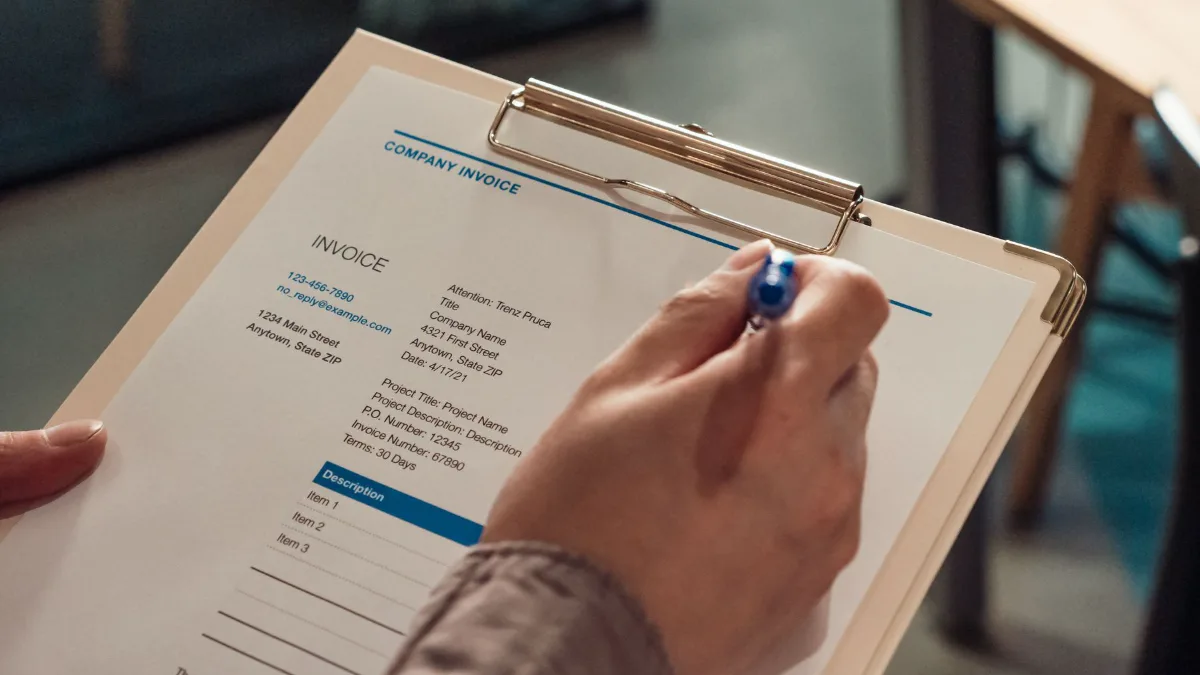
How to Make an Invoice: Step-by-Step Guide
Learn how to make an invoice in 8 clear steps: what to include, how to number it, set payment terms, add tax and send it to get paid on time.
What to Include on an Invoice: Checklist
Every element a professional invoice needs, from numbers and dates to tax and payment terms, with UK, US, Canada and Australia notes.
Invoice vs Receipt vs Bill: The Difference
An invoice asks for payment, a receipt confirms it and a bill is the buyer's word for an invoice. Learn when to use each, with examples.

Invoice Payment Terms: Net 10, Net 30 and More
What invoice payment terms mean: how Net 10, Net 30, 2/10 net 30 and due on receipt work, how to choose the right terms and how to write them clearly.